
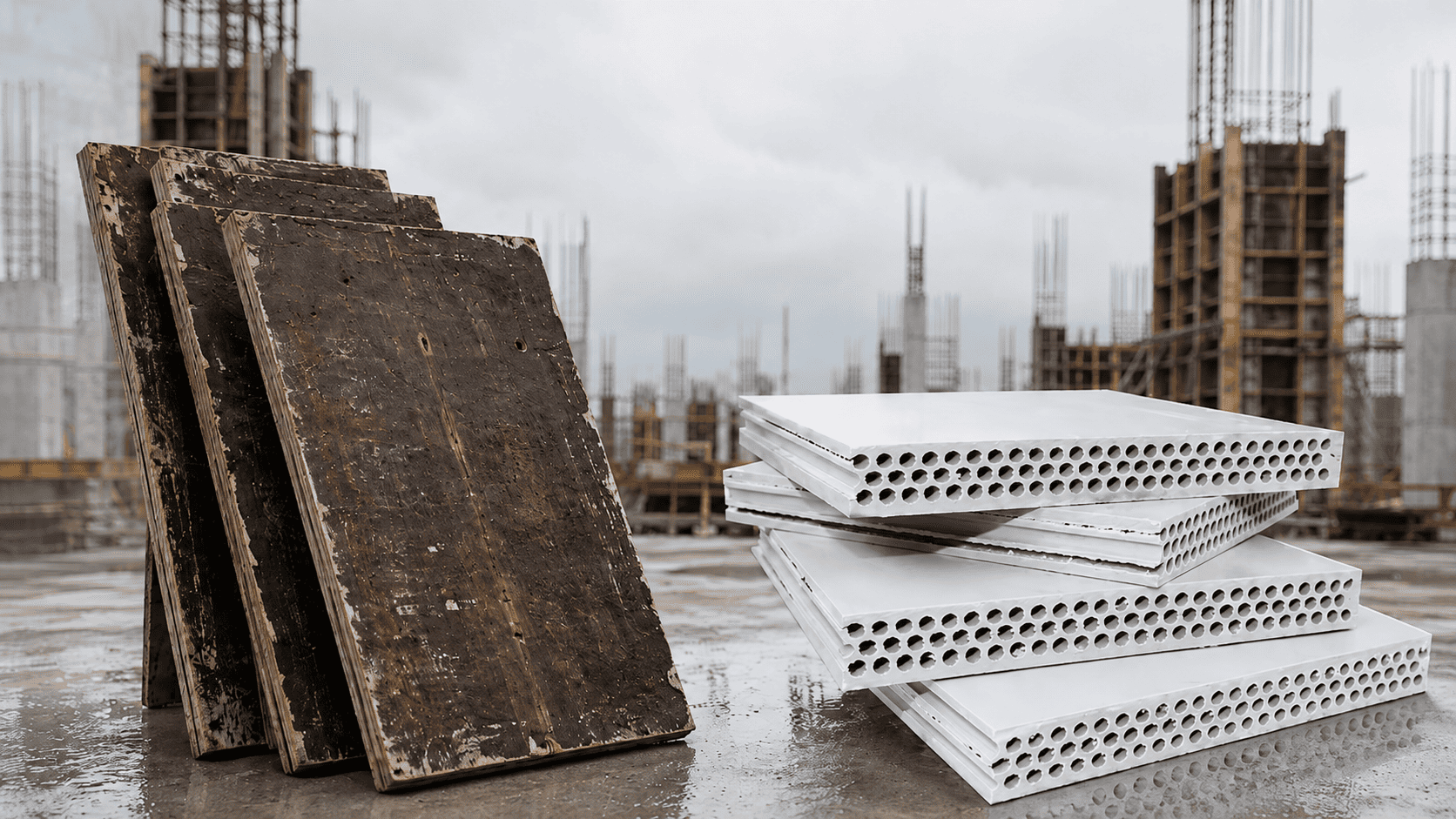


When selecting a formwork solution, the purchase price of a panel is often the first factor considered. However, in professional construction projects, the more relevant metric is the cost per use — the real cost of a formwork panel per concrete pour.
This comparison explains why evaluating formwork materials based on cost per use provides a more accurate and reliable basis for decision-making.
What Determines Cost per Use?
Several factors influence the cost per use of formwork panels:
– Initial purchase cost
– Number of reuse cycles
– Cleaning and maintenance effort
– Scrap and replacement rate
Ignoring these factors can lead to misleading cost comparisons.
Cost per Use of Plywood Formwork
Plywood formwork panels typically have a relatively low purchase price. However, due to water absorption, surface degradation and limited reuse cycles, plywood panels often require frequent replacement.
As a result, the cost per use of plywood can be significantly higher than expected, especially in projects with repeated concrete pours.
Cost per Use of Plastic Formwork Panels
Plastic formwork panels generally have a higher initial purchase cost compared to plywood. However, their resistance to water, dimensional stability and higher reuse cycles significantly reduce the cost per concrete pour over time.
In many applications, plastic formwork panels provide a more predictable and economically efficient solution when evaluated on a cost-per-use basis.
When Cost per Use Becomes Critical
Evaluating formwork based on cost per use is especially important in:
– Large-scale construction projects
– Repetitive casting operations
– Modular formwork systems
– Projects aiming to reduce waste and downtime
While plywood may still be suitable for certain applications, evaluating formwork solutions based on cost per use provides a clearer understanding of long-term performance and cost efficiency.
Plastic formwork panels offer a compelling alternative where durability, reusability and predictable costs are key decision factors.
Values may vary depending on site conditions and handling.