
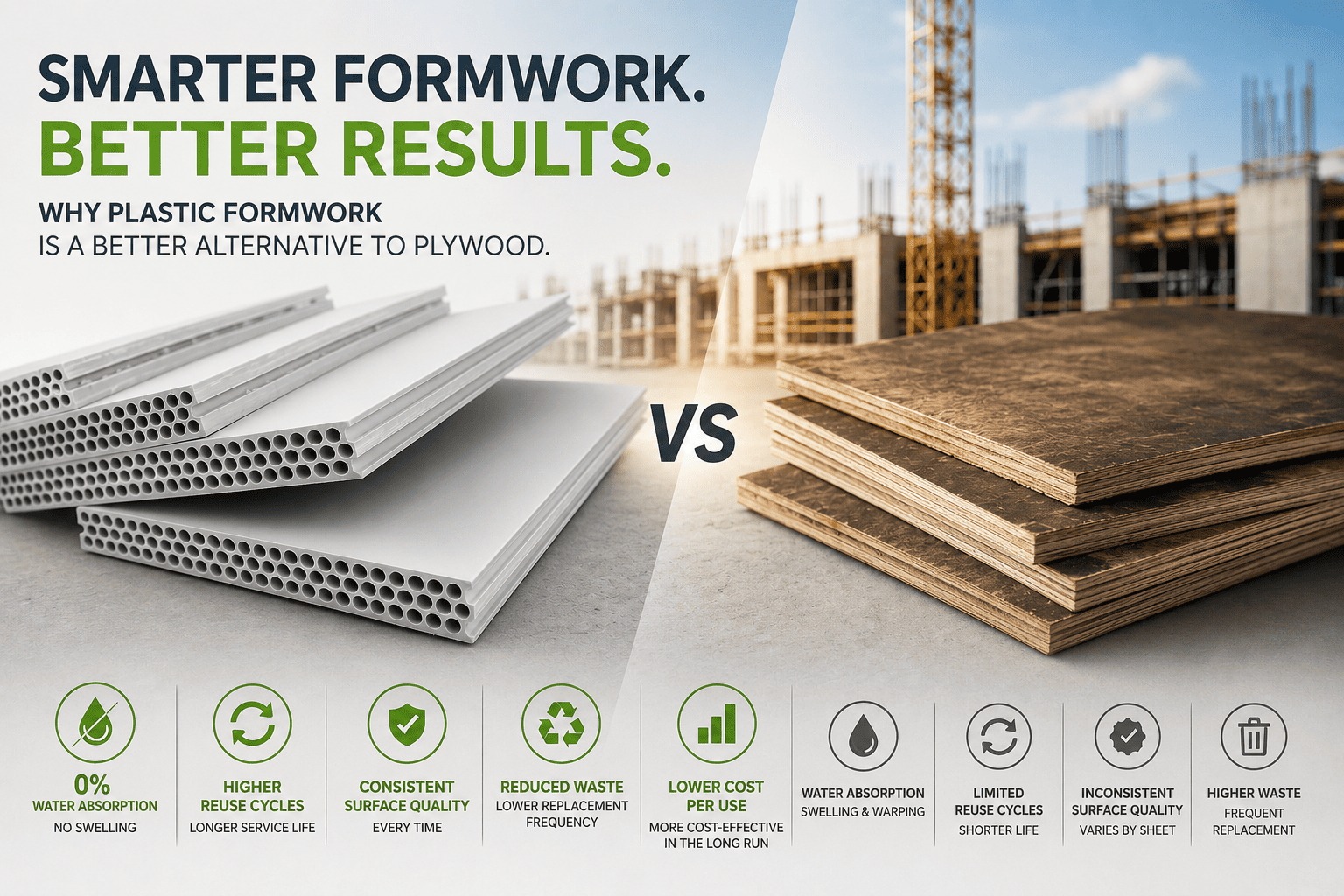


Plywood has been widely used in concrete formwork for decades due to its availability and low initial cost. However, modern construction projects increasingly require more durable, predictable and cost-efficient formwork solutions.
Plastic formwork panels have emerged as a practical alternative to plywood, especially in projects where repeated use, consistent surface quality and lower long-term cost are important.
Limitations of Plywood Formwork
Despite its widespread use, plywood has several limitations when used as formwork:
– It absorbs water, leading to swelling and dimensional changes
– Surface quality degrades after limited reuse cycles
– Performance varies between sheets and suppliers
– Frequent replacement increases waste and operational cost
Advantages of Plastic Formwork Panels
Plastic formwork panels address many of the challenges associated with plywood:
– 0% water absorption eliminates swelling
– Higher reuse cycles provide predictable performance
– Consistent surface quality over time
– Reduced waste generation and lower replacement frequency
Cost per Use: A More Relevant Metric
While plywood often appears cheaper at first glance, the true cost of formwork should be evaluated on a cost-per-use basis. Factors such as reuse cycles, cleaning effort and scrap rate significantly affect long-term costs.
Plastic formwork panels, thanks to their durability and reusability, can offer a lower and more predictable cost per concrete pour compared to plywood.
When Does Plastic Formwork Make Sense?
Plastic formwork panels are particularly suitable for:
– Projects with repeated concrete pours
– Modular and reusable formwork systems
– Contractors aiming to reduce waste and long-term costs
– Applications where consistent concrete surface quality is required
Choosing the Right Formwork Depends on Long-Term Performance
Plastic formwork panels are not intended to replace plywood in every application. However, for many modern construction projects, they provide a more durable, predictable and cost-efficient alternative.
Choosing the right formwork material should always consider site conditions, handling practices and project requirements.
Values may vary depending on site conditions and handling.